PITTSBURGH — Le’Veon Bell remains optimistic about landing a long-term contract with the Pittsburgh Steelers.
Appearing on the NFL Network’s Top 100 broadcast, Bell maintains he’s closer to an extension than last offseason as he enters another summer under the franchise tag.
The network deemed Bell its No. 5 player in the NFL based on a voting system composed of current players.
“Obviously, the people in the organization try to do what’s best for them and I’m trying to do what’s best for me,” Bell said. “We’re working on it. We’re a lot closer than we were last year at this time. That’s what I’m happy about. None of that matters if we don’t get it done. Hopefully we’ll try to get something done. That’s what I’m looking forward to. I got confidence we’ll get it done. I want to do it.”
Bell expressed similar optimism in January from the Pro Bowl, but both sides couldn’t reach an agreement before the March 6 deadline for teams to designate the tag, which will pay Bell $14.5 million this year. The Steelers now have until July 16 at 4 p.m. ET to extend Bell, who has not signed the tag.
The franchise tag allows NFL teams to keep star players on a one-year contract commensurate with the top-five-salaried players at the position. It’s considered a placeholder for negotiations on a long-term deal in earnest.
Bell earned $12.12 million on last year’s tag, and the percentage increases 120 percent on a second tag, 144 percent on a third.
He has been clear he doesn’t want the tag and prefers a lengthier deal with Pittsburgh or, if they don’t want to sign him, another team.
Bell skipped last year’s training camp as a sign of protest, and he’s hinted at a similar plan in 2018 if he’s bound to the tag. Asked what he’ll do differently this offseason in the absence of a new deal, Bell, 26, said “it’s just getting back in the groove with the offense.”
Bell has nearly 8,000 total offensive yards in five seasons despite missing 18 regular-season games.
“When you’re not in there in camp, minicamp, OTAs and things like that, they find different rhythms with different backs in there — whatever player they put in that spot that I would be in,” Bell said. “I’ve got to find a way to get back quicker.”
Bell hopes that means he’s in camp with a future secured in Pittsburgh.
“I don’t want to have … what happened last year,” Bell said. “If it came down to it, then I’ve got to do what I’ve gotta do, take my stand and protect myself. But I don’t want to have to do that. I want to go to camp and play for the Steelers long term.”
“Ten times better (than 2017), 15 times better,” Garrett said with a smile at the team’s golf outing about how much he can improve.
For the record, he was joking about the degree, but Garrett wasn’t joking about expecting a better season. To do that, though, he has to meet the key goal he set for himself after his rookie season: Stay healthy.
“The best quality is availability,” Garrett said during minicamp. “I have to be present.”
It wasn’t Garrett’s fault that he missed five games as a rookie. He hurt his ankle in practice before the opener when a teammate fell on him and caused him to miss four games. He missed the Browns’ trip to London because of a concussion.
But Garrett felt those five missed games plus the time it took to get back to playing shape limited his impact. Even with those, though, he had seven sacks in 11 starts. Projected to a full season, that’s 10 sacks, and a double-digit sack season from a rookie would draw a lot of attention.
But the Browns didn’t draft Garrett first overall a year ago to be very good, and they’ve let Garrett know that.
Myles Garrett had seven sacks in 11 starts last season as a rookie for the Browns. Ron Schwane/AP Photo
“I think that is the challenge maybe John was serving up, and it is no different a challenge than if I would go to Myles,” coach Hue Jackson said. “‘You are supposed to be one of the best players in this league. Go be it every week.'”
Jackson agreed that staying healthy is the first key for Garrett, which in some degree involves not overdoing it off the field.
“He is one of the few guys that I have had to coach that I know I am going to have to keep my hand on to hold back,” defensive coordinator Gregg Williams said. “One of the things with him is his overworking. He works so hard because he does not want to be good; he wants to be great.
“Sometimes he can be his own worst enemy in that respect because he works so hard physically that he has to do a good job with recovery also. The next thing is this — and he knows — if he stays healthy, watch out.”
Garrett’s conditioning has become legendary since he joined the Browns. A year ago he ended training camp practices with a series of 100-yard sprints. This offseason when Garrett ran sprints, Williams said he ran with the defensive backs and receivers.
“They were having a hard time keeping up,” Williams said. “How do you do that as a 280-pound man?”
Another measure of Garrett’s growth is in his knowledge of the game. He admitted that it was an adjustment getting used to the speed of the NFL game.
“It is coming a lot easier,” he said.
A year ago at this time Garrett was coming off a few months of training for the draft, which meant training for the 40-yard dash. This offseason he trained for playing football, which meant concentrating on technique and skills.
Myles Garrett, right, sharing a laugh with Nate Orchard, jokes that he will be “15 times better” than he was as a rookie in 2017. Ken Blaze/USA TODAY Sports
“I feel like I was just a little slow with my hands and not as good as I wanted to be last year with disengaging with the offensive linemen,” he said. “I think that I have really improved.”
The final factor that the Browns feel will help Garrett: a revamped secondary.
The Browns’ self-scouting from last season showed a secondary that could not play press coverage or run with NFL receivers. Changes were made. Jabrill Peppers was moved from free safety to play closer to the line. Damarious Randall was acquired via trade to play free safety. Denzel Ward was drafted fourth overall to provide press coverage. Three other free-agent corners were signed. Peppers is the lone holdover, and he won’t be in the same position.
In theory this means coverage in the secondary should be better, which means the “almost sacks” that Garrett had a year ago will turn into sacks. The Browns believe Garrett was one step from at least a dozen more sacks, perhaps as many as 15-18.
“Allow the quarterback to hold the ball longer than 2.13 seconds, now watch,” Williams said, evidently referring to how quickly opposing quarterbacks got rid of the ball in 2017.
If that was the Browns’ number, it’s shocking. NextGenStats.com tracks the time individual quarterbacks take to throw. None of the 42 quarterbacks it ranked were faster than 2.42 seconds.
ESPN Stats & Information also keeps track of the time it takes quarterbacks to throw against defensive teams. Quarterbacks on teams playing the Browns got rid of the ball in 2.36 seconds, second fastest in the league, according to ESPN Stats. The NFL average: 2.54.
Gauging this stat could be subjective, though. One site’s measurements could differ from another’s, which could differ from a team’s. Suffice it to say that all the stats reflect opposing receivers getting open without much initial opposition, which limits the time the pass rush can get to the quarterback. If the secondary can maintain coverage another second or two, the pass rush becomes that more effective.
But Garrett’s rookie season was not bad by any means, and by some measures, it was excellent. ProFootballFocus actually called him “dominant” when he was on the field. Among the PFF numbers:
37 pressures in 300 passing snaps
A sack or hit on 48.6 percent of his pressures, tied for fourth highest among edge defenders (250 snap minimum)
An overall grade of 88.4, 11th among edge defenders
Multiple pressures in every game he played, with at least three pressures in nine games and one quarterback knockdown in all but one game
PFF called Garrett the best rookie edge defender in the league in 2017 by a healthy margin, and the highest-graded edge defender overall in the AFC North.
It’s not unreasonable to ask: If Garrett did that as a rookie, if he could hit the quarterback on just about 50 percent of his pass rushes when he had injury issues, what might he be able to do in his second season, healthier, with a better knowledge of the game, and with more help around him?
TAMPA, Fla. — Tampa Bay Buccaneers rookie wide receiver Justin Watson can still remember how much his body ached, both the soreness in his legs and the blisters on his feet. It was during a particularly rough stretch of two-a-days the summer going into his senior year at South Fayette High School in McDonald, Pennsylvania.
He can also remember the look on his older brother Tommy’s face when he went to visit him at his group home shortly after. He remembers the car ride full of complaints to his father, Doug, about how grueling practices had become, and how his legs felt like jello during that walk toward the home’s activity room.
Inside was a group of about 30 teens and young adults, all confined to wheelchairs and facing challenges few could imagine — and in the midst of it all, Justin found Tommy, smiling ear to ear.
“He can’t speak, but he smiles and frowns and cries and is pretty responsive with his face,'” said Justin, 23, the Bucs’ 2018 fifth-round pick. “And he was just looking at me, as if to say, ‘If I had just one day in your shoes, I would run all day long, I’d practice all day long, until I was throwing up on the ground and my feet were bleeding, and right when I couldn’t get back up, I’d get back up and start doing it again.'”
That moment was transformative for Justin. He vowed never to complain again — not about football nor the arduous study sessions he would encounter to receive his Ivy League diploma nor, later, the daunting task of making the jump to the NFL, facing tougher competition than what he encountered at the University of Pennsylvania.
“From that moment on, he’s been my inspiration,” Justin said of Tommy. “Whenever it gets tough and whenever I have a bad day, I just realize my brother Tommy would find a way to smile every single day.”
Watson’s mother, Terri, visits with her 28-year-old son Tommy, who has been living at an independent-living facility for the past seven years. Courtesy of the Watson family
‘He’s the toughest kid that I know’
Tommy has cerebral palsy, also known as CP, a neurological disorder that is the result of a brain injury or malformation. It affects motor skills, body movement, coordination, muscle tone and balance.
Tommy, 28, can’t speak or walk. Doctors inserted steel rods along his spine to help correct his scoliosis because it was crushing his organs. He used to be able to feed himself his favorite food, mashed potatoes, but now he relies on a feeding tube.
The Centers for Disease Control and Prevention estimates that CP appears in anywhere from 1.5 to more than four per 1,000 live births. About 40 percent of children with CP have limitations walking or can’t walk at all, with 25 percent who were able to walk as children but lose that ability as they get older. About 30 to 50 percent also have some degree of cognitive impairment.
When Tommy lived with his family, he required around-the-clock care from nurses until he was 21. He now gets that care at an independent-living facility, which is about 15 minutes from the Watson family home in Bridgeville, Pennsylvania.
“He’s the toughest kid that I know,” Justin said. “He’s battling every day, and he fights through things every day. If my legs are burning on the last set of squats, that’s nothing compared to what he goes through.”
It’s Tommy he has thought about during NFL workouts in the oppressive Florida heat and since being sidelined during mandatory minicamp because of injury. It’s Tommy to whom he’ll pay a visit before he reports back to training camp, where he’ll likely start sixth on the depth chart as he tries to play catch-up, probably needing to beat out Freddie Martino, Bobo Wilson and Bernard Reedy to secure a roster spot.
Tommy has always been Justin’s sounding board and source of comfort. When Justin was having second thoughts about attending Penn’s Wharton School — one of the top undergraduate business programs in the country, with an acceptance rate of just 7 percent and students with an average SAT score of 1499 — he went to his older brother.
“I was really scared at first,” said Justin. “He’s a great listener, and I remember sitting there, and I was nervous as heck, and I was like, ‘I think I’m going to go to Penn, but I don’t know.’ I was worried about the school being too hard and if I could do Philly and everything else, and I said, ‘What do you think?'”
“It was probably the biggest smile I’ve ever seen on his face,” Justin said. “To me, it was just reassuring. It seemed like he said, ‘Go for it.’ And I did. It ended up working out great with both football, and I’ll [have graduated] as an Ivy League grad. … I was talking about school being hard and a challenge and he’s looking at me like, ‘Man, you’d be surprised what Watsons can go through. I go through harder things than that just by getting up in the morning.'”
Justin Watson finished his four-year career at Penn as the school’s career leader in receptions (286) and in receiving touchdowns (33), among others. Chuck Cook/USA TODAY Sports
‘Thought everyone had a brother that has special needs’
Justin has also drawn inspiration from his parents, Doug and Terri Watson, who did their best to make life as normal as possible for their four children — Justin, Tommy, Alex, 24, and Abby, 18 — despite Tommy’s condition. They scheduled family vacations around Tommy’s summer camps and got the other three involved in competitive sports.
“I kind of think that growing up, I thought that everyone had a brother that has special needs, or that has someone in their family that needs a little extra care,” Justin said. “I don’t think I fully appreciated how much of a sacrifice it was at first for my parents — their first-born child born with cerebral palsy, and not only the financial stress it puts on you, but just the emotional and mental stress.”
Doug and Terri each had to work two jobs to support Tommy’s medical care. (The CDC estimates the lifetime of medical costs for a person with CP exceeds $1 million.)
Though Tommy would spend about seven hours each day at the Western Pennsylvania School for Blind Children, which also caters to medically fragile students, Terri would work for several other families providing child care.
Doug would work during the day at The Bank of New York Mellon in Pittsburgh doing client service management before working nights at a smaller company doing computer security. He’d pick up extra shifts so he could take off when one of his children had a game, or even to coach one of their teams. Terri would have dinner ready for them before they all got home, then head out the door for a few more hours of work.
“She would pack herself Cheerios and wouldn’t even get to eat the dinner she had made after a full day of work,” Justin said, adding that his parents didn’t sleep well for years because they’d worry about Tommy in the middle of the night. He never heard them complain, either.
“My parents would never say, ‘We had to do this because of Tommy’ or, ‘We had to do this or that.’ That’s just what they needed to do,” Justin said. “They needed to work that many hours to make sure we never needed anything and to [make sure] we were more well off than they were. I don’t think I’ll ever be able to fully appreciate it. But definitely when I got to college and saw, ‘Man, my parents were working 12-hour days for me, I better be putting in at least 12-hour days myself to say thank you to them.”
‘He’s a special young man’
Penn football coach Ray Priore could see that work ethic in Justin. He got the sense Justin was playing for so much more than himself.
“He is a special young man,” said Priore, who had coaches from other sports marvel at Justin’s work habits, wanting to clone him because he’d be the first one out onto the field, 45 minutes early. “He showed up to practice every day as if it was a work day. I think that goes back to a great upbringing — great family life, parents are wonderful people. [They] instilled the values that [he] has, being resilient, and I think that comes from his family background, that resilience and that toughness.
“I’m not sure he had a bad practice in four years or a practice with [less] effort. He’s driven that way. … We always talked about, ‘Success is a choice.’ You can choose to be average or you can choose to be successful. Justin chose to be successful. In everything, he attacks.”
Justin put the betterment of the group before his own needs. He was offered a prestigious internship at Goldman Sachs going into his senior year that would have put him in position to earn six figures right out of college. He turned it down to stay in Philadelphia to work out with his teammates.
He played nearly every skill position on offense aside from Wildcat quarterback. He also attended every special-teams meeting his senior year despite not playing a single snap with the unit, because he felt it was important to know what they were doing at all times.
“I’ve been coaching football for a long time, and I’ve had a lot of real good players that have played, so don’t take this the wrong way, but he’s a young man that really embodied everything as a coach that you say you want to be around,” Priore said. “Whatever it is, he has it.”
What impressed Priore most, though, was the bond Justin developed with a little boy named Vhito DeCapria, who had been stricken with cancer and was adopted by the Quakers football team. Priore saw empathy in Justin’s eyes and a tenderness in his heart.
“It was special to watch this sort of connection between the two,” Priore said. “I think there was definitely a special connection between Justin and Vhito that you sort of [saw] that the twinkle in the eye with it … a very, very special bond.”
Justin understood many of Vhito’s fears, because he lived them with his own family. While Vhito lost all of his hair and went through 40 days of chemo, Tommy had been in and out of the hospital back home.
“He embraced it,” Priore said of Justin. “It’s amazing how many things you can put on a young man’s lap or in his hands — how much can he carry? And he’s had to carry a lot.”
“You can work your way to great things, and you can make a difference, and I know he made a difference in that young man’s life, I’m sure, and in his brother’s life and his family’s life, as well.”
‘The way he’s wired is exactly how you want them’
Justin fits the resilient and committed type of player Tampa Bay general manager Jason Licht and coach Dirk Koetter talked about all offseason. In fact, Licht even told the Glazer family, who own the Bucs, that Justin was one of his “favorite sleepers in the draft.”
“The way he’s wired is just exactly how you want them,” said Licht. “He just loves the game. He’s a blue-collar kid who, one of his major inspirations is his older brother, who has cerebral palsy. It’s just a great story.”
“I really like him,” said offensive coordinator Todd Monken. “He’s big, fast, physical, smart. That’s what you’re looking for: a guy that can develop. Moving forward, those kind of guys rarely underachieve when you have that sort of measurable skill set. So, he’s looked really good at the start and what we looked for.”
No matter the distance
Because of Tommy’s condition, travel has been nearly impossible. He wasn’t able to go to any of Justin’s college games, but it never stopped him from supporting his brother’s football career. While the rest of the family traveled to Philadelphia during the draft so they could be with Justin while he studied for exams, Tommy watched it on TV.
“They said that whenever my name got called, when the soldiers read, ‘Justin Watson,’ they said he started laughing and smiling,” Justin said of Tommy. “It’s awesome. Because you’re not sure if he realizes it or not, but they said he had the biggest smile. And my aunt went and drove there right after to see him and she played a couple of videos that were online and she said he was smiling the whole time, so it was cool to hear that.”
There’s a tiny glimmer of hope that if Justin makes the Bucs’ 53-man roster, Tommy might be able to go to the game against the Cincinnati Bengals on Oct. 28, but it’s still more than four hours of driving.
The good news is that NFL games in the NFL are on TV far more than Penn games.
For now, Doug and Terri visit Tommy about three times a week. Tommy has many friends, including a roommate who has CP. He enjoys swimming, which has served as a form of therapy for him for much of his life thanks to a generous donation years ago from the Make-A-Wish Foundation, something Justin has thought about getting involved with now that he’s a pro. Right now, though, it’s one step at a time.
“He gets me through the hard stuff on a day-to-day basis — the workouts, the extra workouts that you don’t feel like doing, when you’re on your last sprint and you’re thinking about dogging it,” Justin said. “[And] late in games, when the going gets tough — like this year, we were on a four-game losing streak; times like that, when it’s tough to keep getting up, [when you] keep getting hit, just to keep getting up and keep moving forward, that’s when I think about my play and dedicating it to him.”
Justin doesn’t want people to feel sorry for his brother. Not everyone understands what it means for a family that has a child or an adult with special needs. But the Watsons all view Tommy’s life as a gift — a miracle — and they feel fortunate they can bear witness to it.
“I wish more than anything that he didn’t have to go through what he has to go through on an everyday basis, but he truly is a blessing,” Justin said. “If someone with cerebral palsy like my brother can find a way to smile, we can all find a way to smile.”
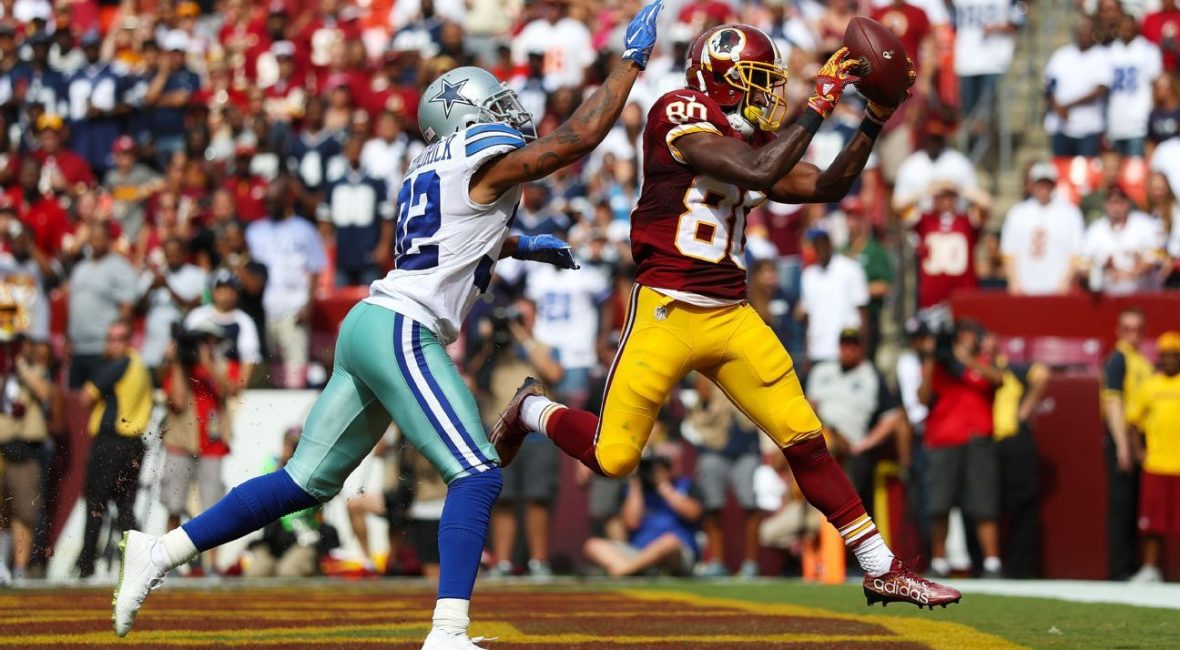
ASHBURN, Virginia — It wasn’t just the quickness that stood out to Washington Redskins quarterback Alex Smith. Nor was it just the way Jamison Crowder caught the ball. Or the routes he ran.
Jamison Crowder is entering his contract season, so he’s been working on staying healthy and establishing a relationship with Alex Smith. Patrick Smith/Getty Images
But Crowder is the most proven of the wide receivers, with three consecutive 60-plus catch seasons as he enters his fourth year. There’s a reason Smith smiles when asked about Crowder, a guy he clearly clicked with this spring.
“Super talented,” Smith said. “Such great feel. Such great instincts. Such great vision.”
It’s a mutual admiration, too.
“He knows the game, he knows how to see defenses, see different coverages,” Crowder said. “By him having that experience, he knows how to put the ball in the right place. … You can already see that we can do a lot of great things as a unit.”
Their skills should mesh quite well once the season begins. Crowder has been productive in his first three seasons, with 192 combined receptions and 12 touchdowns.
His best season in the slot was his second year in 2016 when he averaged 13.43 yards per catch — and had seven touchdowns — when aligned in this area, according to ESPN Stats & Information. Only four players with at least 30 receptions from the slot had a better yards per catch that season.
That season, it was quarterback Kirk Cousins’ second year starting, and the Redskins also had proven veterans such as Pierre Garcon and DeSean Jackson outside. That combination freed Crowder. Also, it allowed for different routes, as the average air yards per target on these throws to Crowder was a career-high 8.29.
Another fact worth noting: In the past five years, Smith owns a combined 102.8 quarterback rating when targeting slot receivers. That’s third best in the NFL over that time for quarterbacks who have made at least 30 starts, trailing only Aaron Rodgers and Russell Wilson. Smith owns the ninth-most completions to slot receivers in that period.
The Redskins hope more of the same follows this season. They have a quarterback patient enough to move the ball underneath in Smith, if that’s what the defense allows.
And it was evident this spring how Crowder can be effective with this offense. The Redskins could clear out areas by aligning him on the same side with Josh Doctson and Paul Richardson, both of whom can make plays down the field. That enables Crowder to work underneath; he’s adept at finding soft spots in zones and has the quickness to better shake man coverage by running across the field to a vacated area.
“That will help out a lot,” Crowder said. “It’s similar to when DJax was here. Paul has that ability to go over the top and the defense has to back up and they have to honor that, and then when [Reed] is back healthy, he’ll definitely open it up for me and other guys as well.”
But what Smith likes can be boiled down to one word: trust.
“He’s so easy to read as a quarterback,” Smith said. “Such great body control, body language. He sees defenses well and it’s hardest to do that in between the hashes. You get so many looks and leverages and you have to handle all those things. He’s decisive and he’s so friendly. He’s always coming back to the ball, always working for you. Those are things you know as a quarterback come crunch time that here’s a guy who will constantly work his tail off to get open. He wants the ball. You love that as a quarterback.”
Crowder’s contract expires after the season, making this a pivotal one for him. But he’s also coming off a year in which he was plagued by hamstring issues. To help, he returned to Duke University this offseason and worked out the way he had when he played for the Blue Devils. He said he focused on his entire body, but he also did more power cleans and hang cleans.
“When I was at Duke, I didn’t have hamstring issues, maybe one or two, so I went back and did more dynamic lifts that I did in college,” he said. “I feel great now … It was frustrating [last year]. When you go out there with a lingering injury, you’re already setting yourself behind.”
“He always gets better because he wants to be a great player,” tight end Vernon Davis said. “He’s a dangerous player. He’s quick, he’s elusive. He can do it all — he can run, catch. He’s one of those players you want on your team.”